
India's AR/VR Revolution: From Smartphone Screens to Virtual Worlds
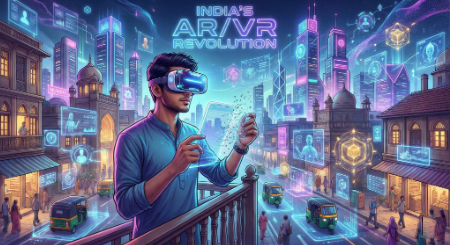
India's AR/VR Revolution: From Smartphone Screens to Virtual Worlds
Picture this: A medical student in Chennai performing complex surgeries in a virtual operating room. A farmer in rural Maharashtra using AR glasses to diagnose crop diseases. A gamer in Bangalore stepping into fully immersive virtual worlds without leaving their living room. This isn't science fiction—it's happening right now in India, and it's growing faster than anyone expected.
The Numbers Tell an Incredible Story
Let's talk numbers, but not in that boring, corporate report way. India's AR/VR market was valued at $4.84 billion in 2023 and is expected to grow at a whopping 38.3% compound annual growth rate through 2032. To put that in perspective, that's like watching your investment double roughly every two years.
But here's what makes it even more interesting: by 2029, user penetration is expected to jump from 44.8% in 2025 to 51.2%. That means more than half of India will be experiencing AR or VR in some form within the next few years. We're not talking about a niche technology anymore—this is going mainstream.
From ₹0.34 Billion to ₹14 Billion: A Journey Worth Telling
Remember 2017? Back then, India's AR/VR market was worth just $0.34 billion. By 2020, it had exploded to $1.83 billion—a 75% compound annual growth rate. That's not gradual growth; that's a rocket launch.
And we're just getting started. The market is projected to hit $14.07 billion by 2027. What's driving this incredible transformation? Let's break it down in a way that actually makes sense.
Why India? Why Now?
The Smartphone Revolution Meets Immersive Tech
India has always been a mobile-first nation. We skipped the desktop era and went straight to smartphones. Now, those same smartphones are becoming gateways to augmented reality experiences. You don't need expensive headsets to try AR—just pull out your phone, and suddenly, you can see how that new sofa looks in your living room or catch Pokémon in your neighborhood park.
The increasing affordability of smartphones and high-speed internet connectivity is making AR & VR more accessible to a larger population. With Jio revolutionizing internet costs and smartphones becoming cheaper every year, technology that once seemed out of reach is now in everyone's pocket.
The Young, Tech-Savvy Population
India has something most developed countries would kill for: a massive young population that's not afraid of new technology. We're talking about millions of millennials and Gen-Z individuals who grew up with technology and are hungry for the next big thing.
Where the Magic Is Really Happening
Education: Making Learning Actually Exciting
Remember those boring textbooks with flat diagrams of the human heart or solar system? Yeah, those are becoming obsolete. Indian edtech companies like Byju's are integrating AR to make learning interactive and engaging.
Imagine studying ancient history by walking through the streets of the Indus Valley Civilization in VR. Or understanding complex physics concepts by manipulating virtual molecules with your hands. That's not the future—it's happening in Indian classrooms right now.
The Government of Karnataka and Meta have embarked on a project to empower 100,000 teachers and 1 million students with digital safety knowledge and AR-VR skills by 2025. When the government starts investing at this scale, you know something big is happening.
Healthcare: Saving Lives Through Virtual Practice
Here's something that'll blow your mind: In July 2024, MediSim VR announced the establishment of Chennai's first Center of Excellence virtual reality lab at Sri Ramachandra Institute of Higher Education and Research, offering immersive VR training for medical students across the nation.
Think about it—medical students can now practice complex surgeries hundreds of times in VR before ever touching a real patient. They can make mistakes, learn from them, and perfect their skills in a risk-free environment. This isn't just cool technology; this is literally saving lives.
Retail: Try Before You Buy, Without Leaving Your Couch
Indian retailers are getting seriously smart with AR. Companies like Myntra, Lenskart, and IKEA are letting customers virtually "try on" clothes, glasses, and furniture before buying.
Here's why this matters: In a country where logistics can be challenging and return rates expensive, AR helps customers make confident purchase decisions. You can see exactly how those glasses look on your face or whether that bookshelf fits your wall—all through your phone's camera.
Gaming: Where 80% of the Revenue Lives
Let's be real—gaming is the killer app for VR. India is becoming a VR gaming powerhouse. The India Virtual Reality Gaming Market reached $4.20 billion in 2024 and is expected to reach $30.20 billion by 2033 at a 21.7% CAGR.
The Indian Startup Ecosystem: Innovation at Full Speed
Here's where it gets really exciting: Over the last few years, nearly 260 startups focusing on the AR/VR segment have been operating in India. Currently, there are 353 Augmented Reality startups and 304 Virtual Reality startups in India.
**Cool Companies Making Waves:**
- **PlayShifu** - Creating physical-digital educational toys that use AR to teach kids STEM subjects
- **AjnaLens** - Manufacturing AR/VR glasses right here in India, working with the Indian Army, Navy, DRDO, Tata, and Mahindra
- **Simulanis** - Specializing in VR training solutions for enterprises
- **Trezi** - Helping architects and designers showcase building plans using AR and VR
- **AutoVRse** - Building enterprise-grade VR training solutions
- **Simbott** - Creating VR simulators for defense and enterprise applications
What's Pushing This Growth?
**Government Support:** In April 2022, Prime Minister Narendra Modi inaugurated Pradhan Mantri Sangrahalay in New Delhi, with Indian startup Tagbin digitizing the museum at an estimated cost of $40 million.
**Big Money Flowing In:** Reliance Jio invested $15 million in TWO, a Silicon Valley-based startup focused on AR/VR. Flipkart launched "Flipkart Labs" to enhance e-commerce through AR.
**5G: The Game Changer:** As 5G rolls out across India, the lag that plagued early VR experiences will disappear, making the technology smooth and responsive.
The Challenges (Because Nothing's Perfect)
- **Cost Barriers:** Quality VR headsets are still expensive for the average Indian consumer
- **Awareness Gap:** In rural areas, many people still don't know what AR/VR is
- **Content Shortage:** We need more India-specific, culturally relevant content
- **Infrastructure Issues:** Rural connectivity is still catching up
The Bottom Line: Why This Matters to You
Whether you're a student, professional, entrepreneur, or just someone curious about technology, India's AR/VR revolution will touch your life. Maybe it'll be through the way you learn, shop, work, or play.
The exciting part? We're still in the early days. The infrastructure is being built, the ecosystem is growing, and Indian innovators are proving they can compete with the best in the world.
The AR/VR market in India isn't just growing—it's exploding. And the best part? You can be part of it. Whether you're creating content, building applications, investing in startups, or simply being an early adopter, there's room for everyone in this revolution.
The virtual future isn't coming. It's already here. And it's being built in India, by Indians, for India—and the world.