
Animation vs VFX: Differences, Skills, Career Paths and Which One to Choose
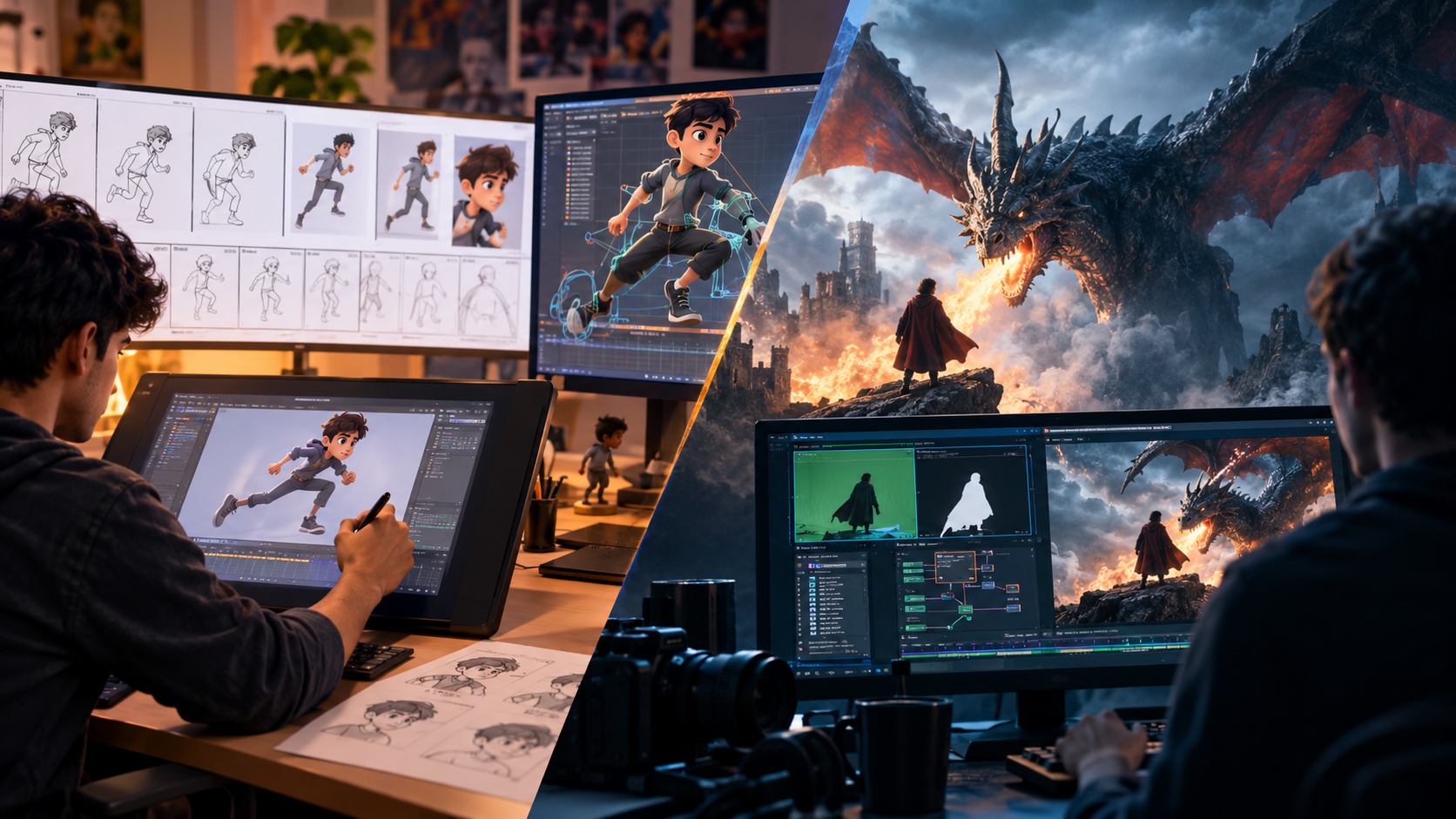
If you enjoy animated characters, cinematic worlds, films or digital effects, you may be deciding between Animation and Visual Effects (VFX). The two fields often work together, but they focus on different creative problems. Animation is primarily about creating movement and performance. VFX is primarily about creating, changing or integrating visual elements so that a finished shot tells the intended story convincingly.
Neither field is automatically better. The right starting point depends on the work you want to practise, the skills you are willing to develop and the kind of portfolio you want to build. This guide compares the workflows, skills, project examples and possible career paths, then gives you a practical way to test your fit.
Quick answer: Animation vs VFX
| Factor | Animation | VFX |
|---|---|---|
| Main purpose | Create movement, character performance and animated scenes | Create, remove, enhance or combine visual elements within a shot |
| Typical starting material | Drawings, 2D elements, 3D models, rigs or designed assets | Live-action footage, CG elements, plates, masks and digital assets |
| Core tasks | Plan action, pose, animate, refine timing and render | Track, mask/roto, key, paint, composite and match image properties |
| Main quality test | Does the movement feel clear, believable and expressive? | Do the elements look as if they belong in the same shot? |
| Portfolio example | A short character animation or movement study | A before-and-after composite with a breakdown |
| Possible entry roles | 2D/3D animator, character animator, layout/previs artist | Roto artist, compositor, tracking/matchmove artist, junior FX artist |
These are broad distinctions, not strict boundaries. A production can use a CG-animated creature in live-action footage, then use compositing to integrate it. Animation and VFX can overlap, even when individual artists have different responsibilities.
What is Animation?
Animation creates the illusion of movement by changing drawings, objects or digital assets over time. An animator plans how a character or object moves, reacts, expresses emotion or interacts with its environment. Animation may be 2D or 3D, and the workflow varies by format, production and specialisation.
Skills used in Animation
- Timing and spacing: controlling the speed, rhythm and pauses of an action.
- Posing and body mechanics: communicating balance, weight, intention and clear silhouettes.
- Observation: studying how people, animals and objects move.
- Performance and storytelling: making actions and expressions understandable.
- Technical workflow: working with relevant assets, rigs, animation tools and review processes.
Example project: a 10-second character action
Imagine a beginner project in which a character picks up a heavy box, struggles with its weight and places it on a table. The student plans the action, blocks key poses, refines timing and body mechanics, then improves the final performance. The central test is whether the action communicates weight and intention—not simply whether the model moves.
Animation may be worth exploring first if you enjoy character movement, visual storytelling, expressive poses or building animated sequences. Drawing can be useful in some areas, especially 2D animation and visual development, but expectations differ across specialisations.
What is VFX (Visual Effects)?
Visual Effects (VFX) involves creating, changing or integrating visual elements so a shot communicates something that could not easily be filmed as-is, or so separate elements appear to belong in the same image. VFX is used in film, streaming content, advertising and other video production.
Skills used in VFX
- Compositing: combining image layers into one coherent shot.
- Rotoscoping and masking: separating a person or object from other parts of an image.
- Keying: extracting suitable foreground elements from a background, often a green screen.
- Tracking and matchmoving: aligning digital elements with camera or object movement.
- Image integration: matching lighting, colour, perspective, edges, grain and depth.
- Troubleshooting: identifying why a composite looks artificial and correcting the underlying issue.
Example project: replacing a street background
Imagine footage of an actor standing on an ordinary street. The brief is to place the actor in a futuristic city. The student analyses the footage, tracks the camera if needed, isolates the actor, prepares the digital background, matches perspective and lighting, adjusts colour and integrates the layers. The central test is whether the actor and environment look like parts of one convincing shot.
VFX may be worth exploring first if you enjoy transforming footage, combining real and digital elements, spotting small image mismatches and solving detailed shot-level problems.
How the workflows differ
A simplified Animation workflow
Brief and reference → plan/storyboard → assets or rigs → blocking and key poses → timing and movement refinement → lighting/rendering as required → review and final output.
A simplified VFX workflow
Shot brief and footage → analyse plates and requirements → tracking, roto or keying as needed → prepare or create elements → composite and match image properties → review and refine → final shot delivery.
Real productions can include more stages, specialised departments and repeated reviews. These workflows are examples, not universal production rules. Some stages overlap: a VFX shot may include an animated CG creature, while an animation project may use compositing to combine layers.
Software and technical learning: what should you check?
Software varies by studio, specialisation and curriculum. Animation training may include tools for 2D/3D animation, modelling, rigging or rendering. VFX training may include compositing, rotoscoping, tracking or simulation tools. Some tools are shared across pipelines, so a software name alone is not enough to judge a course.
Before enrolling, ask the institute:
- Which tools are taught in the current syllabus, and for which tasks?
- Will I complete guided exercises and full projects rather than only software demonstrations?
- Are fundamentals such as timing, composition, perspective and image integration taught alongside tools?
- Can I see relevant student work and understand what the student personally created?
- Will instructors review projects and allow time for revisions?
Career paths in Animation and VFX
These are possible role families, not guaranteed job outcomes. Job titles, entry requirements and responsibilities vary by employer, location, production type and experience.
Possible Animation roles
- 2D Animator: creates movement for 2D productions.
- 3D Animator: animates digital characters, objects or scenes.
- Character Animator: focuses on action, emotion and character performance.
- Layout or Previsualisation Artist: helps plan camera, staging and scene composition.
- Other specialisations can include modelling, rigging, lighting or storyboarding, depending on skills and training.
Possible VFX roles
- Compositor: combines layers and elements into a coherent final shot.
- Roto Artist: creates mattes or masks to isolate moving subjects.
- Tracking/Matchmove Artist: helps align digital elements with camera or object movement.
- FX Artist: creates simulations such as smoke, particles, fluids or destruction, depending on specialisation.
- Other specialisations can include paint, matte painting, lighting or VFX supervision as experience develops.
For either path, build a focused portfolio or showreel that demonstrates relevant skills. A few clear, well-explained pieces are more useful than a collection of unrelated work. Include breakdowns where they help viewers understand your process and contribution.
Which is better after Class 12: Animation or VFX?
Neither is universally better. A more useful question is: which kind of creative problem would you be willing to practise repeatedly?
| Animation may suit you if… | VFX may suit you if… |
|---|---|
| You enjoy character action, movement or performance. | You enjoy combining, enhancing or repairing shots. |
| You notice when movement feels too fast, slow, heavy or unnatural. | You notice mismatches in lighting, colour, edges or perspective. |
| You want to build an animated sequence or digital performance. | You want to create a convincing composite or visual effect. |
| You are willing to revise poses and timing repeatedly. | You are willing to troubleshoot fine details until elements integrate. |
Try this before choosing
- Animation test: create a short bouncing-ball or simple character movement study. Review timing, weight and clarity.
- VFX test: use suitable footage and a separate visual element to make a basic composite. Review edges, perspective, lighting and colour.
- Compare the process: Which task made you curious enough to keep improving? Which type of feedback helped you most?
This is a reflection exercise, not a formal aptitude test. If both tasks interest you, look for a programme that clearly explains which areas it teaches, how deeply each is covered and where learners can specialise.
How to choose an Animation or VFX course
Review the actual syllabus
Check whether the programme focuses on 2D animation, 3D animation, compositing, FX simulation or a combined pipeline. Course titles can hide important differences.
Inspect relevant student projects
Ask to see animation sequences, compositing shots or showreels. Look for work that demonstrates the skills you want to learn, and clarify the student's contribution.
Understand the learning process
Look for practice, instructor feedback, revisions and projects that progress from foundational to more complex.
Confirm eligibility and qualification
Verify minimum qualification, duration, fees and the exact certificate or degree awarded directly with the institute.
Ask about portfolio support
Confirm what projects you will complete and whether feedback is available for presentation and showreel preparation.
Evaluate career-support claims
Ask what support is provided and request evidence for placement or employment claims. A course should not be treated as a job guarantee.
Can you learn both Animation and VFX?
Yes. Some learning pathways introduce connected parts of both disciplines. However, a combined course does not automatically teach every area in depth. Check how much time is allocated to animation fundamentals, compositing, tracking, simulation and complete practical projects.
If you are unsure, try one small project in each area before committing to a specialisation. Compare not only the finished result but also the process: planning movement and performance differs from diagnosing and integrating visual elements in a shot.
Frequently asked questions
What is the main difference between Animation and VFX?
Animation focuses on creating movement and performance. VFX focuses on creating, changing or integrating visual elements within a shot. A production may use both.
Which is better: Animation or VFX?
Neither is universally better. Compare the work you enjoy, the curriculum, the projects you want to build and the skills required for your preferred roles.
Can I study Animation or VFX after Class 12?
Many training routes are available after Class 12, but eligibility varies by institution and programme. Check the exact entry requirements and qualification awarded before applying.
Do I need drawing skills for Animation?
Drawing can be useful in areas such as 2D animation and visual development. Some 3D roles place greater emphasis on timing, movement, observation and digital workflows.
Is VFX the same as video editing?
No. Editing arranges footage into a sequence, while VFX creates or integrates visual elements within shots. The two may be used together in post-production.
What should I include in an Animation portfolio?
Depending on the role, include a short animation, movement studies, character performance or a breakdown that clearly shows your process.
What should I include in a VFX portfolio?
Depending on the role, include before-and-after shots, compositing breakdowns, tracking or roto work, and a clear explanation of your contribution.
Can Animation and VFX overlap?
Yes. A production can combine animated CG elements with live-action footage and use compositing to integrate them. The core responsibilities and skills still differ.
Explore Animation and VFX learning options
If you are comparing Animation and VFX courses, start with the actual curriculum and the projects you would complete. Review the current Animation and VFX courses and the 3D Animation & VFX programme. Confirm current availability, eligibility, duration, fees, software coverage and qualification details directly from the live website or admissions team.
If Animation and VFX are listed as separate programmes, use their respective live course pages. If only a combined programme is offered, describe it accurately rather than implying that separate courses are available.
Compare the curriculum and practical projects, then contact the admissions team to discuss which learning path fits your interests.